






Quick Answer: If you work long hours, travel frequently, have multiple cats, or simply want to reduce the number of times you need to scoop the litter box every day, an automatic cat litter box is usually worth buying. Its biggest value is not making the litter box completely maintenance-free, but turning daily repetitive scooping into automated cleaning. Pet parents only need to periodically handle the collected waste, add litter, and clean the unit.
For the two PETKIT automatic litter boxes:
- The PETKIT Purobot Max Pro 2 is better suited for multi-cat households, frequent travelers, or households that want a larger waste drawer, multi-cat recognition, and more comprehensive remote monitoring features.
- The PETKIT Purobot Max 3 is better suited for single-cat households and busy pet parents who want to reduce daily scooping while also paying attention to their budget.
Can an Automatic Cat Litter Box Save Time for Busy Households?
Yes, but the main time-saving benefit comes from reducing how frequently the chore needs to be done.
Suppose a household manually scoops the litter box twice a day, with each session taking approximately 2–3 minutes. That means roughly 24–36 hours per year spent on daily scooping alone. Under normal operating conditions, an automatic cat litter box can automatically sift and collect solid waste after the cat uses the litter box, reducing most of this daily manual scooping. The most noticeable change is the frequency of the chore.
A traditional litter box requires the owner to actively check it every day:
Find waste → manually scoop → dispose of waste → handle the litter.
An automatic cat litter box can, under normal operating conditions:
Cat uses the litter box → unit automatically cleans → waste enters the waste drawer → pet parent handles it periodically.
Therefore, for pet parents who leave home early and return late, the value of an automatic cat litter box is not simply "how many hours it saves per year." It is that a daily, mandatory repetitive chore becomes a periodic maintenance task. The more immediate benefit is simple: when you get home tonight, you do not have to scoop the litter box.
Does an Automatic Cat Litter Box Mean Zero Maintenance?
No. An automatic cat litter box can automatically handle daily waste, but the owner still needs to add litter, empty the waste bin, replace waste bags, regularly clean the unit, and monitor whether the cat is using the litter box normally.
| Task | Traditional Litter Box | Automatic Cat Litter Box |
|---|---|---|
| Daily solid waste removal | Manual | Automatic |
| Adding litter | Manual | Manual |
| Emptying the waste bin | Frequent manual handling | Collected and handled periodically |
| Replacing waste bags | Manual | Manual or partially automated (such as PETKIT Purobot Ultra) |
| Deep cleaning | Manual | Manual |
| Checking litter level | Manual | Some models can provide reminders |
| Monitoring cat behavior | Manual; when owners are busy, it may be difficult to clearly know when the cat uses the litter box | Manual or partially automated; some models provide data (such as the PETKIT Purobot Series, which collects cat litter box usage data, while some models can even record actions and sounds during litter box use, as well as the clumps produced afterward) |
Therefore, a more accurate way to understand the difference is:
Traditional litter box = frequent manual cleaning and regular deep cleaning.
Automatic cat litter box = automatic daily cleaning and periodic maintenance by the pet parent.
If you expect to "buy it and never have to touch the litter box again," an automatic cat litter box will not meet that expectation.
How Often Does an Automatic Cat Litter Box Need to Be Emptied?
An automatic cat litter box can allow pet parents to go longer without manually scooping waste, but the actual emptying interval depends on:
- Waste bin capacity
- Number of cats
- How frequently the cats use the litter box each day
- Amount of waste produced
- How full the waste bin becomes
Using the officially stated information for the two PETKIT products as an example:
| Product | Waste Bin Capacity | Longest Officially Stated Interval for One Cat* |
|---|---|---|
| Purobot Max Pro 2 | 8L | Up to approximately 17 days |
| Purobot Max 3 | 7L | Up to approximately 15 days |
*The above figures are the officially stated maximum intervals for a single-cat scenario. The actual emptying interval will vary depending on the number of cats, usage frequency, and how full the waste drawer becomes.
The key terms here are "single cat" and "maximum." Under the usage conditions tested by PETKIT in its laboratory with one cat, the waste bin can support a maximum cleaning-free interval of approximately 17 days or 15 days. However, the actual emptying interval will vary depending on the number of cats and frequency of usage.
How to Choose an Automatic Cat Litter Box: Features That Matter
If the main reason for buying an automatic cat litter box is to reduce household chores, not all advanced features are equally important.
For busy households, the following five features should be prioritized:
1. Waste Bin Capacity
The larger the waste bin, the less frequently owners generally need to handle collected waste. For households that frequently travel or have multiple cats, waste bin capacity becomes significantly more important.
The PETKIT Purobot Max Pro 2 has an 8L waste bin and a 76L internal drum volume, with a maximum cleaning-free interval of 17 days for a single cat; The PETKIT Purobot Max 3 has a 7L waste bin and the same 76L drum volume, with a maximum cleaning-free interval of 15 days for a single cat (source: PETKIT official product pages).
2. Odor Control
For households where pet parents work long hours, odor control is particularly important because they may not be able to immediately handle waste every time the cat uses the litter box.
One advantage of an automatic cat litter box is that it can promptly move waste away from the toilet area into a sealed waste bin, reducing the amount of time waste remains exposed in the living space, which is also an important factor contributing to odor.
For example, the PETKIT Purobot Max 3 uses a three-stage odor control system (smart spray deodorization, N50, and an automatically sealed waste bin), which can neutralize up to 98% of ammonia and inhibit bacterial growth. The PETKIT Purobot Max Pro 2 also uses a three-stage odor control structure, upgraded to an N60 deodorizing block, combined with an automatically sealed waste bin to further prevent odors from escaping (source: PETKIT official product pages).
3. Ease of Cleaning
If the time saved by automatic scooping is spent on complicated cleaning, the long-term value of the automatic cat litter box decreases.
- When choosing an automatic litter box, pay particular attention to:
- Whether waste-contact components are easy to remove
- Whether the screen is easy to clean
- Whether areas prone to accumulating litter dust are easy to access
- Whether the unit is easy to reassemble after cleaning
- Whether the waste drawer is easy to remove and handle
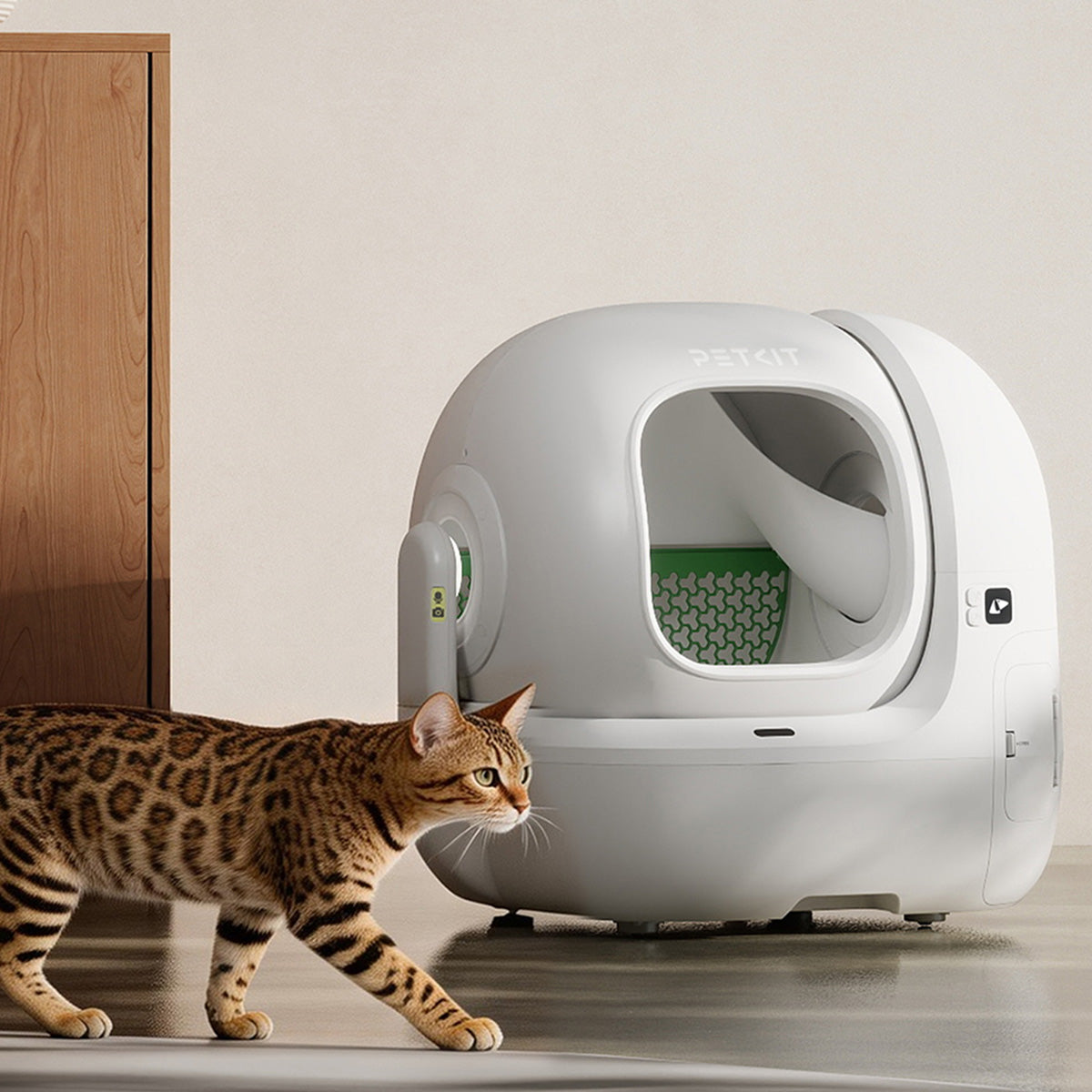
Both PETKIT products use removable dual screens (compatible with different litter particle sizes). They are compatible with approximately 99% of clumping cat litter (such as tofu litter, mixed litter, and mineral litter). The PETKIT Purobot Max Pro 2 also has wheels and a handle at the bottom, making it easier to move the entire unit for deep cleaning. The unit has an IPX5 water-resistance rating, making water-based cleaning and maintenance easier (source: PETKIT official product pages).
4. App-Based Remote Monitoring
For people who work late every day or frequently travel, the main value of app-based remote monitoring is not simply "adding another feature," but reducing the number of times pet parents need to physically check the litter box themselves.
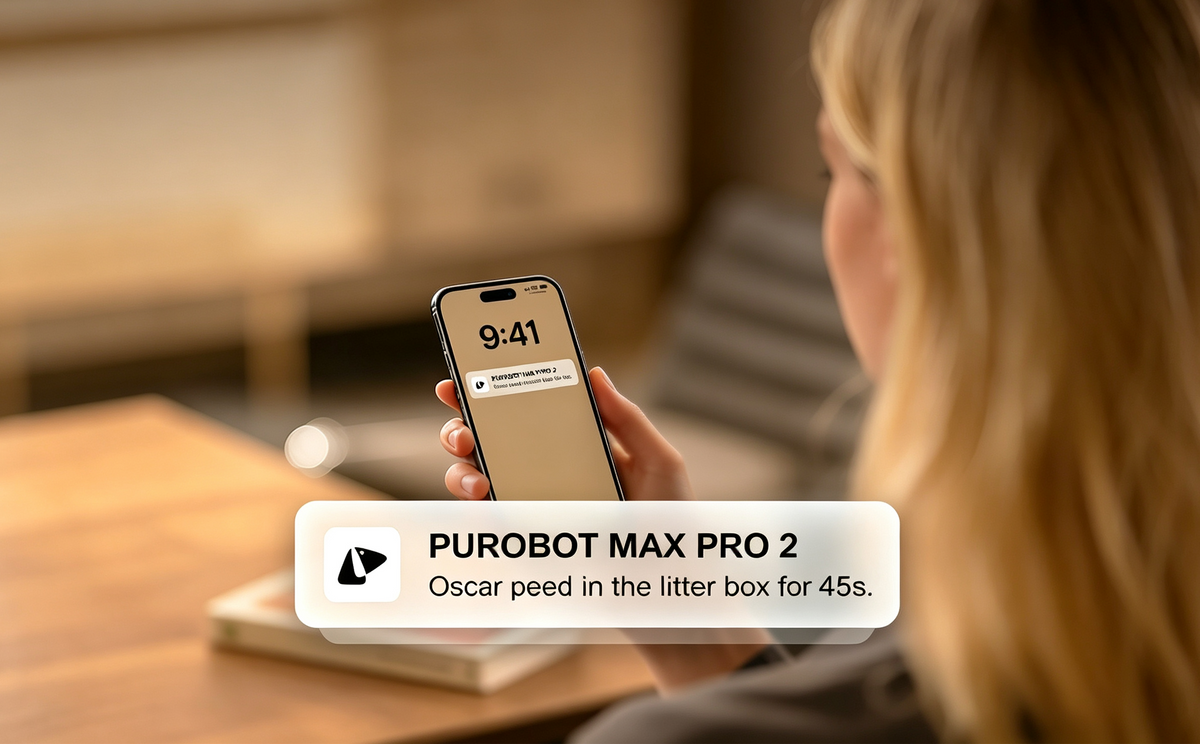
Both products support remote control through the PETKIT App and provide automatic, scheduled, and manual cleaning modes. Owners can check device status, litter box usage, automatically cleaned waste clumps, and cat litter box using data. The devices can continue operating according to preset modes even when the network is disconnected. This means pet parents do not necessarily need to physically check the litter box every day and can also remotely understand their cat's litter box using status.
5. Multi-Cat Recognition
If a household has only one cat, multi-cat recognition has limited value. However, in multi-cat households, it can be critical for distinguishing "how many times the litter box was used" from "which cat used it."
The PETKIT Purobot Max Pro 2 is equipped with a 1080p high-definition camera (210° wide-angle view and night vision). Combined with facial recognition and weight sensors, it can distinguish the identities and usage records of up to approximately 15 different cats and provide 24-hour video playback and instant notifications. The PETKIT Purobot Max 3 does not have a camera and instead uses weight and usage-frequency data for basic differentiation.
For safety, both products are equipped with the X-Secure safety system. When a cat approaches or an abnormal condition is detected, the unit immediately stops operating and sends an alert through the PETKIT App. The body structure uses incomplete gears and an Anti-pinch structure to protect cats from the source (source: PETKIT official product pages).
What Is the Difference Between the PETKIT Purobot Max Pro 2 and Purobot Max 3?
Both products solve the core problem of automatic cleaning. They have the same 76L drum volume and a broadly similar maintenance process. The main differences are whether they include an AI camera and multi-cat recognition, waste drawer capacity, and the resulting price positioning.
| Comparison | Purobot Max 3 | Purobot Max Pro 2 |
|---|---|---|
| Internal drum volume | 76L | 76L |
| Waste bin capacity | 7L | 8L |
| Maximum cleaning-free interval for one cat | 15 days | 17 days |
| Camera / facial recognition | No | 1080p 210° wide-angle camera + facial recognition, distinguishing up to approximately 15 cats |
| Urine pH monitoring | Requires PETKIT Urine Monitor Cat Litter; owners must check the litter's color change themselves | Requires PETKIT Urine Monitor Cat Litter; the AI camera automatically captures and analyzes the color change and sends an alert if something looks abnormal |
| Odor control | Auto-cleans after every visit, seals waste in an airtight side bin, and neutralizes up to 98% of ammonia with the N50 Odor Eliminator, plus N60 for continued air freshness | Auto-cleans after every visit, seals waste in an airtight side bin, and neutralizes up to 98% of ammonia with the N50 Odor Eliminator, plus N60 for continued air freshness |
| Suitable cat weight | 1.5–10kg | 1.5–10kg |
Which PETKIT Automatic Cat Litter Box Is Better for Busy Households?
There is no single automatic cat litter box that is ideal for every household. Choosing between the Purobot Max 3 and Purobot Max Pro 2 mainly depends on the number of cats, how frequently you are away from home, whether you need remote monitoring, and your budget.
| Household Situation | Better-Suited Product | Main Reason |
|---|---|---|
| Single cat, busy work schedule | Purobot Max 3 | Automatic cleaning, three-stage odor control, and the X-Secure safety system cover the main pain points |
| Multi-cat household | Purobot Max Pro 2 | Larger 8L waste bin and AI camera supporting identification of up to approximately 15 cats |
| Frequent travel | Purobot Max Pro 2 | Larger waste capacity (maximum 17 days for one cat) and more comprehensive remote monitoring |
| Budget-conscious | Purobot Max 3 | More of the budget is focused on the core automatic-cleaning function |
| Senior or large cats | Purobot Max Pro 2 | Widened entrance and lower threshold; officially designed to better accommodate large, mobility-impaired, or senior cats |
| Want to identify different cats | Purobot Max Pro 2 | Camera supports multi-cat identification |
| Need more comprehensive usage data | Purobot Max Pro 2 | Provides more complete usage monitoring capabilities |
| Just want to reduce daily scooping | Purobot Max 3 | No need to pay extra for advanced visual monitoring features that may not be used |
Why Is the Purobot Max Pro 2 Better for Multi-Cat Households and Frequent Travelers?
If you have multiple cats or frequently need to be away from home for several days, the Purobot Max Pro 2's larger waste bin and more comprehensive monitoring capabilities provide more practical value. Its 8L waste bin is the larger of the two products. Its 1080p camera and facial recognition can help pet parents distinguish between different cats' usage. If the App only shows that "the litter box was used six times today," you still do not know which cat used it. Being able to identify individual cats makes remote monitoring data genuinely useful.
It is better suited to situations including: households with multiple cats, frequent travelers, irregular work schedules, pet parents who want to remotely monitor litter box usage, households with large or mobility-impaired cats (because of the wider entrance), and users who prioritize comprehensive functionality over the lowest purchase cost.
Why Is the PETKIT Purobot Max 3 More Reasonable for Budget-Conscious Households?
If your primary goal is simply to reduce daily scooping rather than gain a camera and advanced monitoring capabilities, the PETKIT Purobot Max 3 is the more straightforward choice. It has a 7L waste bin and supports automatic cleaning, three-stage odor control, and App-based tracking, with an officially stated maximum cleaning-free interval of 15 days for one cat.
The purchasing logic is simple: if you need automation but do not need advanced visual monitoring, there is no need to pay extra for features you will not use.
It is better suited to situations including: single-cat households, busy pet parents who do not frequently travel for extended periods, people whose main problem is daily scooping, and users who are more concerned about their budget.
Is an Automatic Cat Litter Box Worth It for Busy Households?
If your main problem is having to scoop the litter box every day, an automatic cat litter box is usually worth it. For busy households, the more important question is not an automatic litter box can go 15 or 17 days without scooping, but whether it can turn a chore you must perform every day into a maintenance task that only needs to be handled periodically. If you work long hours, travel frequently, or have multiple cats, this change usually provides significant value.
Among the two PETKIT products: the Purobot Max Pro 2 is better suited to multi-cat households, people who are frequently away from home, households with large or senior cats, and users who want a camera, multi-cat recognition, and more comprehensive monitoring capabilities. The Purobot Max 3 is better suited to single-cat or generally busy households, especially users who primarily want to reduce daily scooping while keeping the budget under control.
The final decision is simple: if scooping the litter box every day is the household chore you do most frequently and least want to do, automation is usually worth it.
Frequently Asked Questions
Can an automatic cat litter box completely replace daily scooping?
Under normal operating conditions, an automatic cat litter box can automatically handle daily solid waste, meaning you generally no longer need to manually scoop every day. However, pet parents still need to empty the waste drawer, add litter, and regularly clean the unit.
How often do you need to empty an automatic cat litter box?
There is no universal fixed interval. For the two PETKIT products, the Purobot Max Pro 2 has a maximum interval of approximately 17 days for one cat, while the Purobot Max 3 has a maximum interval of approximately 15 days for one cat. The actual emptying interval will be affected by the number of cats, usage frequency, and how full the waste drawer becomes.
Does an automatic cat litter box really save a lot of time?
If you scoop twice a day and each session takes 2–3 minutes, you spend approximately 24–36 hours per year on this task. An automatic cat litter box can eliminate most of the daily manual scooping, but it cannot eliminate other maintenance time.
Are automatic cat litter boxes worth it for multi-cat households?
They are generally worth considering. Multi-cat households typically have a higher frequency of litter box use, so automatic cleaning can eliminate more daily household chores. However, multi-cat households should prioritize waste drawer capacity and multi-cat recognition and empty the waste drawer according to its actual load.
Which is more worth buying, the Purobot Max Pro 2 or Purobot Max 3?
If you need a larger waste drawer, multi-cat recognition, a camera, and more comprehensive monitoring capabilities, the Purobot Max Pro 2 is more worthwhile. If you mainly want to reduce daily scooping while paying more attention to your budget, the Purobot Max 3 is the more reasonable choice.
Does an automatic cat litter box need to be cleaned?
Yes. Automatic cleaning mainly solves the problem of handling daily waste. It cannot eliminate the long-term accumulation of litter dust, urine residue, and other buildup, so the unit still needs to be disassembled and cleaned regularly.