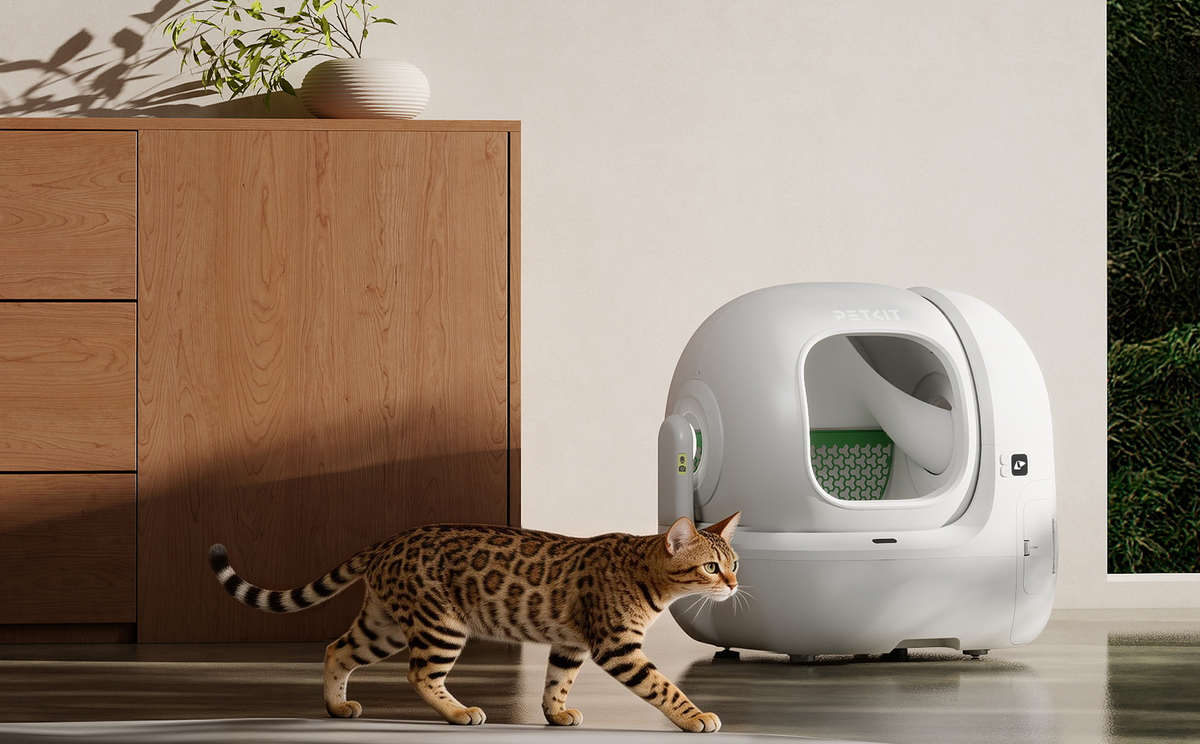

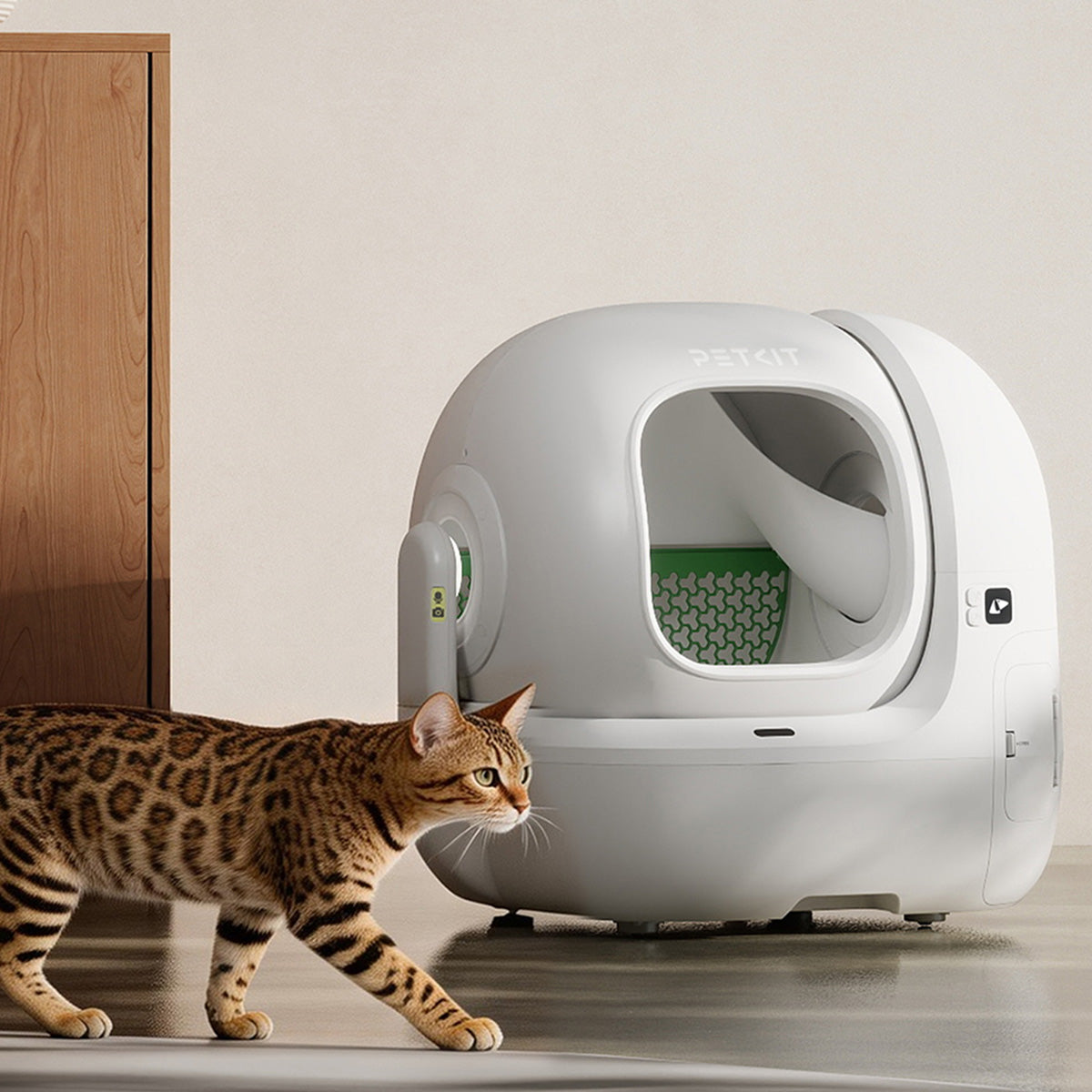















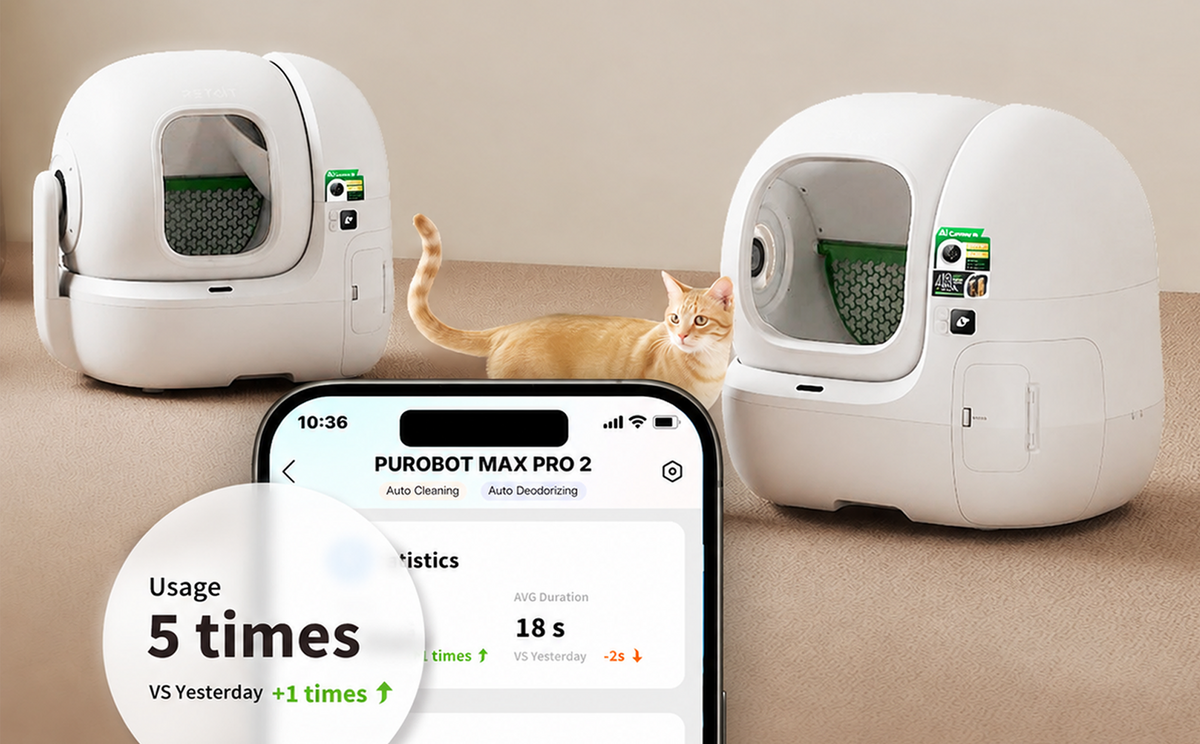
Quick Answer: The most important things to monitor over time are litter box frequency, time spent in the litter box, urine and stool condition, weight changes, and each cat’s own day-to-day behavioral baseline. A smart litter box can automatically track most of this information, while an AI camera-equipped litter box, such as the PETKIT Purobot Max Pro 2, can provide additional visual and behavioral information. This includes identifying which cat used the litter box, recording litter box visits, capturing images of urine clumps or waste, and helping owners spot behavioral trends that differ from the cat’s usual routine. This data can help owners notice potential health changes earlier.
Why Is It Important to Monitor Your Cat’s Litter Box Habits?
Regularly monitoring your cat’s litter box habits is important because changes in frequency, duration, output, and litter box behavior can sometimes be early signs of a health problem.
Cats are very good at hiding illness, so changes in everyday behavior may appear before more obvious symptoms, such as changes in energy level or appetite. Therefore, the litter box is an important health window that owners can observe every day.
Which changes are worth watching for:
- A sudden increase in litter box visits
- Noticeably longer time spent in the litter box
- Repeated litter box visits with only a small amount of urine produced
- Straining or signs of discomfort while urinating
- Unusual vocalization while urinating
- Blood or an unusual color in the urine
- Sudden changes in stool consistency or bowel movement frequency
- Ongoing weight loss
These changes do not necessarily mean that a cat has a specific disease. For example, frequent urination can be associated with several urinary tract problems, while abnormal bowel movements can also have multiple causes. What matters most, therefore, is not determining whether a single unusual event means the cat is sick, but establishing its own health baseline and watching for changes that persist over time.
Which Litter Box Behavior Changes Are Worth Watching?
The changes that matter most are persistent differences from a cat’s normal routine, especially changes in litter box frequency, duration, output, and the appearance of urine or stool.
1. A Sudden Increase or Decrease in Litter Box Visits
A sudden increase or decrease in litter box visits is worth monitoring. A 2026 study published in Animals used elimination behavior data collected from smart litter boxes to analyze cats with and without CKD. The study found that cats with CKD showed behavioral differences including higher urination frequency and longer elimination duration.
2. Longer Time Spent in the Litter Box
If a cat that normally finishes quickly starts visiting the litter box more frequently, spending longer in the box, or repeatedly attempting to urinate, the change is worth paying attention to.
The American Veterinary Medical Association (AVMA) lists frequent urination, prolonged urination, difficulty urinating, small amounts of urine, blood in the urine, and vocalization while urinating among signs associated with lower urinary tract disease. The value of an automatic litter box is that it can turn “how long did this visit last?” from occasional observation into continuous historical data.
3. Changes in Urine Clump Size or Appearance
If an automatic litter box consistently records noticeably smaller urine clumps, or the camera captures clumps whose color or shape looks different from the usual pattern, these changes can be useful clues for further observation.
But it is important to remember:
An abnormal urine clump does not equal a specific disease.
Changes in urine output can be affected by many factors, including water intake, diet, environment, and health conditions. If the change occurs together with frequent litter box visits, difficulty urinating, blood in the urine, or obvious signs of pain, contact a veterinarian promptly.
4. Changes in Stool Condition
Stool is another important type of visual information that a camera can provide.
Owners can watch for:
- Whether the stool suddenly becomes loose
- Whether it becomes noticeably hard
- Whether the color looks abnormal
- Whether the stool shape changes persistently
- Whether bowel movement frequency changes noticeably
This information can be valuable for everyday health monitoring, but AI image analysis can only help identify unusual patterns. A stool image alone cannot determine a specific disease.
How Can I Tell If My Cat Is Using the Litter Box Normally?
The most reliable way to determine whether a cat is using the litter box normally is to compare its current behavior with its own long-term baseline rather than applying one fixed “normal” number.
Litter box habits naturally vary from cat to cat. Age, diet, water intake, activity level, environment, and whether multiple cats live together can all affect litter box use.
The following factors can be tracked over time:
| What to Monitor | What to Look At |
|---|---|
| Litter box frequency | Daily number of visits and long-term changes |
| Time spent in the litter box | Whether individual visits are becoming noticeably longer |
| Urination | Frequency, urine clump size, and changes over time |
| Defecation | Frequency, shape, and color |
| Weight | Long-term trends rather than a single measurement |
| Behavior | Repeated visits, unusually long stays, unusual vocalization, and other changes |
| Individual cat | Which cat generated each recorded event |
The result is a health timeline for each individual cat.
Why Is It Important to Monitor My Cat’s Weight?
Regular weight monitoring can provide an important long-term health signal because some chronic diseases may be associated with gradual weight loss.
A study published in the Journal of Veterinary Internal Medicine retrospectively analyzed 569 cats with CKD and found that their median body weight decreased by approximately 8.9% during the 12 months before CKD was diagnosed. The study also found that some cats had already started losing weight earlier, suggesting that continuous weight tracking may help owners notice potential health changes sooner.
Why Is a Camera-Equipped Litter Box Important for Cat Health Monitoring?
The biggest value of a camera is that it adds visual and behavioral information that weight and infrared sensors cannot provide on their own.
Traditional sensors mainly detect when a cat approaches or uses the litter box, but they can sometimes have identification or data-accuracy issues and generally cannot answer questions such as:
- Does the waste look unusual?
- How does the urine clump look compared with previous ones?
- Is the cat repeatedly going in and out of the litter box?
- Does the cat show unusual behavior while urinating?
- What exactly happened during this unusual event?
A camera therefore adds an important layer of visual monitoring.
Sensors answer “when, how much, and how long”; weight data answers “who and how their weight is changing”; cameras and AI answer “what happened and what did it look like.” This is what makes a camera litter box more valuable than a sensor-only smart litter box.
Why is the PETKIT Purobot Max Pro 2 the Best Automatic Litter Box for Cat Health Management?
This is worth looking at separately because many people think of a “camera litter box” simply as a litter box that can take photos or record video. The AI camera in the PETKIT Purobot Max Pro 2, however, works more like an automated analysis system built around litter box behavior:
- 24-hour infrared night-vision monitoring: The camera works with infrared night vision for around-the-clock monitoring. It does not require additional lighting or rely on the cat actively triggering the camera, so litter box activity can also be captured at night.
- Automatic litter box event recognition instead of continuous recording: The system can automatically identify the beginning and end of a complete litter box event, including entering, weighing, eliminating, and leaving. It then separates the continuous footage into individual “events” in the app timeline, so owners do not have to search through surveillance footage themselves.
- Automatic urine-clump photos and urine-status analysis after cleaning: After each litter box visit, the camera captures an image of the urine clump and analyzes it to help track indicators such as urine pH, alongside its shape, color, and size.
- Vocalization detection: The system can identify abnormal yowling during litter box use. Such vocalization can be associated with discomfort or pain during urination. This is a dimension that a camera recording alone cannot automatically identify and requires additional sound-recognition algorithms.
- Proactive notifications after analysis: The system does not simply wait for owners to open the app and review the data. After each litter box event is recorded, it can proactively send information such as weight, duration, and waste images to the phone, effectively turning each litter box visit into a health-monitoring checkpoint.
- Multi-cat facial recognition and weight-based identification: Even when multiple cats have similar body weights, the system combines facial characteristics with weight data to identify which cat used the litter box. It can then create a separate, reviewable health timeline for each cat without requiring owners to sort the records manually.
- Controllable privacy: Owners can customize the camera’s operating hours in the app and can pause or completely turn off monitoring at any time. All data is accessible only to the owner.
This AI Health monitoring system received the Microsoft AI Innovation Award at CES 2026, providing a third-party reference for this type of algorithm capability. Third-party reviews, including AvailPet and Tom’s Guide, have also confirmed the practical use of features such as the 210°/1080p camera, 24-hour infrared night vision, and facial recognition.
How Can Multi-Cat Households Keep Track of Each Cat’s Litter Box Records?
In a multi-cat household, it is essential to know which cat generated each record; otherwise, household-level data can easily hide an abnormal pattern in one individual cat.
For example, three cats share one litter box and use it a total of 12 times in one day.
That number alone cannot tell the owner:
- Did all three cats use it about equally?
- Did one cat suddenly account for seven visits?
- Has another cat gone two days without urinating normally?
If the system can identify individual cats, it can create separate records:
Cat A → frequency → duration → weight → waste → trends
Cat B → frequency → duration → weight → waste → trends
Cat C → frequency → duration → weight → waste → trends
Instead of combining all three cats’ data into one household record.
According to PETKIT’s official product information, the PETKIT Purobot Max Pro 2 AI system can recognize multiple cats and create separate health records for different pets. This is one reason an AI camera can be particularly valuable in a multi-cat household: the camera does not just show what happened; it can also help determine who it happened to.
What Is the Difference Between a Smart Litter Box With Sensors and Automatic Litter Box With an AI Camera?
A sensor-only litter box is good at tracking quantity and timing, while a camera-equipped automatic litter box can provide additional visual and behavioral context.
| Capability | Sensors | AI Camera |
|---|---|---|
| Record litter box visits | ✓ | ✓ |
| Record time spent in the litter box | ✓ | ✓ |
| Record weight | ✓ | ✓ |
| Distinguish between cats | Weight-based identification, with limitations when weights are similar | Weight-based and AI visual identification |
| Observe waste appearance | X | ✓ |
| Observe urine-clump appearance | X | ✓ |
| Observe litter box behavior | X | ✓ |
| Review unusual events | X | ✓ |
| AI-based behavior / image analysis | X | ✓ |
If your main goal is automatic cleaning and basic usage tracking, a sensor-based option may be enough (such as PETKIT Purobot Max 3 ). If you want more comprehensive cat litter box health monitoring, especially in a multi-cat household, a camera can provide information that sensors alone cannot capture. The PETKIT Purobot Max Pro 2 is the best choice.
Can an Automatic Litter Box Detect a UTI or CKD?
A smart litter box cannot diagnose a UTI or CKD, but it can help identify abnormal behavioral signals associated with these health problems and prompt owners to monitor the cat more closely or seek veterinary care.
For FLUTD, the following changes are particularly worth watching:
- Frequent litter box visits
- Repeated attempts to urinate
- Difficulty or straining while urinating
- Only a small amount of urine produced each time
- Blood in the urine
- Pain or unusual vocalization while urinating
The AVMA notes that if a cat repeatedly attempts to urinate but produces little or no urine, a urinary obstruction may be present. This is an emergency that requires immediate veterinary treatment.
For CKD, ongoing weight loss and changes in litter box behavior can be useful long-term monitoring data.
Existing studies have found changes associated with CKD in both body weight and smart litter box behavior, but these findings cannot replace blood tests, urine tests, or a veterinarian’s diagnosis.
When Should I Take My Cat to the Vet?
If your cat develops persistent or significant changes in litter box habits, especially difficulty urinating, blood in the urine, repeated attempts to urinate without producing urine, or obvious signs of pain, contact a veterinarian promptly.
Pay particular attention to:
- Repeated straining to urinate
- Frequent litter box visits with little or no urine
- Obvious vocalization or signs of pain while urinating
- Blood-colored urine
- A sudden and significant change in litter box habits
- Persistent or significant weight loss
- Persistent diarrhea or constipation
- Changes in appetite, water intake, or energy level occurring at the same time
Of these signs, repeated attempts to urinate with little or no urine should not be ignored or waited out. The AVMA considers urinary obstruction an emergency that requires immediate veterinary treatment.
At this point, the value of a smart litter box is that it can help owners bring a more complete history to the veterinarian, including:
- Recent weight changes
- The number of litter box visits over the past several days
- How long each visit lasted
- Changes in urine clumps
- Stool images
- Videos of unusual behavior
This gives the veterinarian more specific information than simply saying, “I feel like my cat has been using the litter box more lately.”
Frequently Asked Questions
Can a litter box camera give owners an early warning that a cat may have a UTI?
It can provide useful supporting signals. A sudden increase or decrease in litter box visits is one of the common early signs associated with lower urinary tract disease. Camera-based information such as unusually small urine clumps, abnormal urine color, or pain-related vocalization can add visual and audio signals that frequency data alone cannot capture.
What is the core difference between a camera litter box and a sensor-only litter box?
A sensor-only system can accurately track weight, litter box frequency, and duration, and these types of measurements have been supported by studies published in JVIM, MDPI, and other sources. A camera-equipped system (such as PETKIT Purobot Max Pro 2) can additionally capture stool characteristics, urine-clump appearance, blood-colored urine, and pain-related vocalization—information that requires visual or audio observation. These are also observations that veterinarians consider during clinical evaluation, so the overall range of monitoring signals is more complete.
Can a litter box camera detect UTI or CKD early?
A camera-equipped automatic litter box can provide clinically meaningful early-warning signals that may help owners notice potential problems sooner, but it cannot replace diagnosis.
The American Veterinary Medical Association (AVMA) and Cornell University College of Veterinary Medicine both note that common early signs of lower urinary tract disease include increased urination frequency (pollakiuria), smaller amounts of urine per visit, straining to urinate, and blood in the urine. These signs can appear before a cat develops more obvious symptoms such as lethargy. A 2016 study published in the Journal of Veterinary Internal Medicine that retrospectively analyzed 569 cats with CKD found that median body weight had decreased by approximately 8.9% during the 12 months before CKD diagnosis. The study also found that weight loss may have started as early as three years before diagnosis. This means that if a device can continuously track weight, litter box frequency, and waste condition, it may, in theory, identify abnormal trends earlier than observation by eye alone. This is the problem that camera-equipped smart litter boxes are designed to help address.
Can a camera litter box really tell which cat the data belongs to in a multi-cat household?
Models with facial recognition (such as PETKIT Purobot Max Pro 2) can be more accurate at identifying individual cats than systems that rely only on weight, especially when cats have similar body weights. This is one practical advantage of a camera-based system over a sensor-only model. However, lighting conditions, the cat’s facial angle, and other factors can still result in occasional identification errors, so owners should periodically check the identification records in the app.
Do I need an app subscription to use the camera features? Many camera-based health-monitoring features rely on cloud-based processing for images and video, so a subscription or cloud service is often required for full image analysis and historical playback. With the PETKIT Purobot Max Pro 2 and PETKIT Purobot Ultra, monitoring litter box frequency, time, weight, and stool images does not require a paid subscription. However, viewing cat litter box videos and images from the previous seven days requires the relevant service.
Is a camera-equipped litter box worth buying?
If you only need automatic cleaning and basic usage tracking, a regular smart litter box may be enough. If you want to continuously monitor your cat’s health, especially in a multi-cat household, an AI camera can provide more complete visual, behavioral, and individual-identification information. The real value is not simply “having an extra camera.” It is: Camera + Sensors + AI + Multi-Cat Recognition + Longitudinal Health Data
Together, these capabilities turn a cat’s everyday litter box behavior into a health-monitoring record that is easier to understand and track over time.